Creator tech stack 2026: Discover the best sleek, affordable software alternatives to ditch expensive enterprise subscriptions and boost your freelance profits.
The truth is, “Subscription Fatigue” is the occupational illness of our generation.
The message to creators, freelancers, and growing businesses for years has been this: to be taken seriously, you needed serious software. Which means locked-in contracts with enterprise giants for years on end, for a hundred features you’d never use while your bills creep up every January.
But as we enter 2026, the play has completely changed. The democratization of tech, due to the rapid evolution of AI, has ensured that the playing field is level. The moat that protected the expensive and bloated software monopolies has run dry.
Now, a solo producer working out of a home office can rival a full-fledged agency department with solutions that cost a fraction of the price , or nothing at all in some instances.
It’s no longer a matter of showing me the budget for your tools, but showing me your tech stack. It’s all about agility and keeping your hard-earned revenue as profit instead of seeing it drift off in software costs.
As we’ve surveyed the current state of affairs, we’ve compiled the ultimate creator freedom stack 2026—game-changing, affordable alternatives that make high-end enterprise software unnecessary.
1. The Visual Design Revolution: Escaping the Subscription Rent
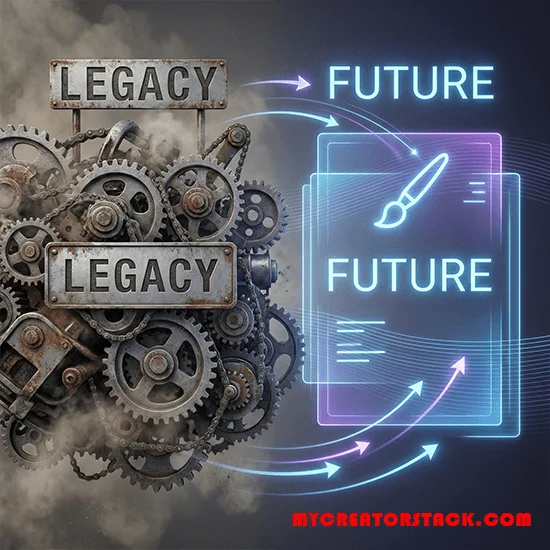
For over a decade, there has been only one giant in the design world, casting an enormous purple shadow. The paid subscription to design capability was akin to a design tax. However, in 2026, design capability is not locked away behind an enormous paywall.
There’s a new breed of design software that understands that today’s designers need speed and cross-platform compatibility, not mere power hidden beneath two decades’ worth of menus.
- The New Standard: Canva Pro & Affinity V3
Despite being labeled a simple tool for non-designers, Canva’s recent 2025-2026 AI integrations have turned it into a force to be reckoned with in rapid asset creation. For 90% of all social graphics, presentations, and ‘general marketing,’ its speed is unbeatable.
However, for those who need professional-grade vector and image editing but can’t stand the toll of the subscription-based costs, the Affinity suite of apps (Designer, Photo, and Publisher) is the unchallenged leader of the pack. Their “buy once, and it’s yours forever” policy is a refreshing statement in today’s market. Today, in 2026, the set of core design apps from the company is hard to beat in terms of feature sets, delivering a sleek, blazing-fast performance.
2. Hollywood Production Value on an Indie Budget
Video is now considered the universal language of the internet, and in the past, it had a high cost attached to it—often requiring four-figure software fees in order to put together a professional reel.
Now, the same editing tools that Oscar-winning editors have access to are available for free.
- The Powerhouse: DaVinci Resolve
It is amazing to see how Blackmagic Design is offering a free version of DaVinci Resolve to users. The free version is not some sort of freemium offer, but is actually a professional editing and color grading solution used in Hollywood films and TV shows.
Where expensive, business-level competitors charge a fee each month for basic editing capabilities, Resolve provides approximately 95% of what a premium content creator would want for free. While the learning curve isn’t as straightforward as a mobile app, the potential isn’t limited.
- The Speed Demon: CapCut Desktop
For bite-sized content where the only thing that matters is getting it out the door quickly, CapCut has grown from a novelty on a smartphone into a full-fledged desktop application. AI-powered captioning, intuitive cuts, and a set of hip effects allow a creator to produce a high-quality vertical video faster than is possible in a traditional non-linear editor.
3. The “Second Brain”: Operations Without the Enterprise Bloat
Many creators are stuck in the expensive theater of productivity when working on projects, clients, and internal knowledge. An enterprise project management system, designed for 5,000 employees, imposes rigid and complex workflows on small teams and suppresses creativity.
You don’t need a sledgehammer to crack a nut. What you need is a flexible digital workspace.
- The Organizer: Notion (AI-powered)
Notion by 2026 is a full-fledged operating system for creatives. It eliminates the need for multiple costly subscriptions, such as wiki software, a basic project management board, or a document collaboration service. The AI capabilities within Notion allow you to question your own database. This converts passive knowledge into active knowledge.
Instead of having to shell out money for four different specialized SaaS tools that do not communicate with each other, savvy creatives are establishing custom operating systems on Notion for a fraction of the price.
4. The Engine of Growth: CRM and Marketing Automation
The term Customer Relationship Management (CRM) is often associated with very large, expensive, complex databases that need a special person to administer. For a creator who’s selling digital products, services, or memberships, these legacy systems are too much.
- The alternative to Agile: HubSpot (Free/Starter Tiers) & ConvertKit
But where enterprise CRMs charge thousands for seats you don’t use, companies such as HubSpot have made bold investments in their free and lower tiers for smaller businesses. You receive powerful contact management, basic email marketing, and pipeline tracking that’s more than sufficient to scale up into the seven figures.
And for the creators who are most interested in newsletters and audience ownership, ConvertKit (now increasingly marketed more directly towards creator identities) is a hell of a lot better than a generic enterprise email blast. It’s designed for selling digital products, not running a Fortune 500 sales team.
Building Your Creator Tech Stack 2026
Building your tech stack in 2026 isn’t just about finding cheaper versions of existing tools. It’s about rethinking your entire workflow to leverage AI and modern, agile software.
The creators who are doing the best right now aren’t bragging about how much their software costs. They are boasting about how lean, speedy, and profitable their operations have become. They are wielding tools that honor their time and wallet.
It’s time to take inventory of your subscriptions. Are you paying for a name on the tin, or results?? The tools mentioned above demonstrate that in 2026, you no longer have to choose between professional quality and financial freedom. You can have both.
(Disclaimer: The information given in the article is for information purposes only, and the information is based on personal opinions and research. MyCreatorStack is not responsible for any decisions made based on the information given in the article. The links given in the article are affiliate/advertising links.)

Sandaru is a senior graphic designer with over 5 years of experience in brand identity, digital design, and creative workflows. He founded Mycreatorstack to help designers and freelancers navigate AI tools, design software, and the evolving creator economy — without the hype.
Leave a Reply