
Learn how to build a scalable one-person agency using advanced AI tools. Replace bloated payrolls with automated systems and grow your solo empire.
In many industries, success has followed a predictable pattern over several years. First, you’re a scrappy freelancer, then you get busier and hire a junior, then an account manager, and eventually a finance person. Before you know it, you’re no longer doing the creative work you love, and you’re supervising people, worrying about HR issues, and fretting over a large monthly payroll.
But in the last 18 months, a quiet revolution has completely rewritten this entire business model. A new type of entrepreneur is rising in competitive digital industries. This new entrepreneur is earning agency-level revenues and working with enterprise clients, yet their “Meet the Team” page has only a single image.
They’re not just freelancers working long hours. They’re building a highly profitable one-person agency, replacing entire teams with advanced AI solutions.
This isn’t only about using ChatGPT to write a bad email. It’s a fundamental change in what it means to run a business.
From “Tool User” to “AI Orchestrator”
The common mistake is to think of AI purely as a way to make existing processes more productive or a slightly faster way to do what you are already doing.
But the entrepreneurs who are succeeding today have a different view of AI. They see AI as autonomous agents.
Some of the recent tech council discussions highlight this change. We’re no longer talking about prompting AI, but instead, about the era of AI agents that can handle complex, multi-step processes without being constantly prompted.
For example, the classic agency model is:
- The Creative Dept: Ideation, drafting, designing.
- The Ops Dept: Scheduling, invoicing, project management.
- The Marketing Dept: Outreach, analytics, strategy.
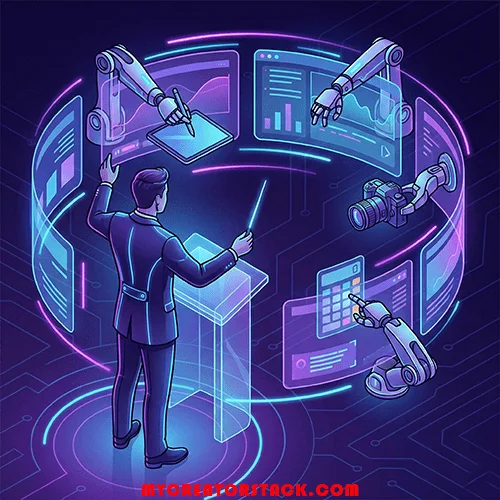
Of course, the one-person agencies that are succeeding today does not have the time,, money, or interest to handle all of this manually. They have an orchestra of AI tools that handle all of this for them. They go from being the one playing all the instruments to being the conductor of the orchestra.
The Death of the Mid-Level Task
So, where does this impact land most directly? In the repetitive, data-heavy tasks that once required teams of juniors.
Let’s think about Influencer Marketing. In the past, to execute an Influencer Marketing campaign, one would require a small army of juniors to scout influencers, authenticate audience authenticity, send hundreds of DMs to influencers, negotiate rates, and measure results. All of this was grueling work.
However, with the advent of advanced AI technology, it is now possible to scan thousands of profiles in an instant, detect fake followers through anomaly detection, craft personalized emails to influencers based on their recent content, and predict ROI for the campaign before spending a single dollar.
What once took a three-person team to accomplish is now a Tuesday morning task for one strategic operator running a one-person agency.
The same goes for creating content. We’re not just creating content anymore. We’re using technology that allows us to take one video concept, write the script, create the storyboard, create the social media versions of that video, write the blog post that goes with that video, and schedule that on five different platforms.
The human still creates the spark, but the AI does the heavy lifting.
The Reality Check: Taste is the New Gold
Before you go marching off to fire your team or installing dozens of applications, there is a critical reality check to be had.
There is a big difference between creating mediocre content and creating high-end, game-changing content. New studies on the film and TV industry have shown that AI technology is plateauing in areas that require high levels of nuance, emotional intelligence, and cinematic artistry.
If you are in a business model that relies on creating mediocre, low-tier content, then you will be replaced by AI technology.

The concept of the one-person agency is not a way for people to be lazy; it is a way for people to think on a higher level. If execution is easy, then the value is on the creativity, emotional intelligence, and strategic direction, which AI technology still cannot replicate.
The successful solopreneur will use AI technology to eliminate administrative drudgery, freeing themselves up to focus on the 90% of their business that is client relationships and creativity. Rather than using AI technology to become average faster, they use it to become better at the things that matter most.
The New Skill Stack for the Solo Empire
If you want to transition from an overworked freelancer to a scalable one-person agency, focus less on improving your Photoshop skills and more on improving your systems. (Read my complete guide on the best AI tools for freelancers in 2026 to see exactly what to add to your workflow).
The new essential skills are:
- Prompt Engineering & Agent Management: The ability to “speak machine” in order to get high-quality, practical output instead of generic fluff.
- Systems Architecture: Knowing how to hook up different AI tools, such as your CRM AI tool with your content AI tool, using automation tools such as Zapier or Make.
- Strategic Curation: Knowing how to select the one AI idea out of ten that will really click with people. Taste can’t be automated.
The Arsenal: Tools That Build the Empire
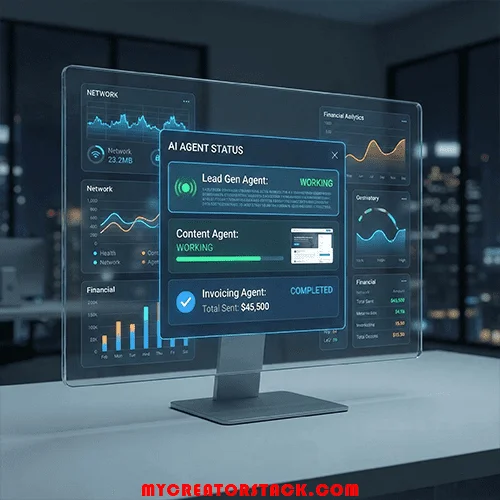
While theory is good, to actually execute on that theory, you need to have the right infrastructure in place. The one-person agency isn’t built using disparate apps. It’s built using a cohesive suite of automation tools.
To replace a whole team, you will need a full set of tools to cover operations, sales, and administration. The following are the basic tools you will need:
- The Digital Nervous System: Zapier (or Make). This is the glue that holds everything together. This ensures that your emails work with your project management tool, your leads work with your CRM, and your invoices work with your bank. Don’t try to make this work yourself; you will be wasting your time. Zapier makes all this work together so you don’t have to.
- The Second Brain: Notion AI. Your brain isn’t big enough to hold all these SOPs, client notes, and marketing calendars. Notion AI is your one-stop shop. It’ll help you organize your projects and even write strategies for you inside your workspace.
- The Growth Engine: HubSpot. The key to growth is relationships. To grow your business, you need a top-notch CRM that can handle email marketing and sales automation. With these tools, one person can do the work of five.
Don’t think of these tools as individual tools. Think of them as a stack. When these tools are properly integrated, they don’t just help you get more done. They do the work for you.
The Final Pivot
The barrier to entry for starting a one-person agency has been eliminated. The barrier to creating an exceptional one has never been higher.
We’re on the cusp of a period of unprecedented competition. Agile, AI-driven creators will thrive , while bloated, slow traditional agencies will struggle to keep up. You don’t need permission, capital, or manpower to create something monumental. All you need is a sense of vision, taste, and the right combination of agents.
The question isn’t whether or not you can afford this model. It’s how long you can survive if you can’t.
(Disclaimer: The information given in the article is for informational purposes only, and the information is based on personal opinions and research. MyCreatorStack is not responsible for any decisions made based on the information given in the article. The links given in the article are affiliate/advertising links.)

Sandaru is a senior graphic designer with over 5 years of experience in brand identity, digital design, and creative workflows. He founded Mycreatorstack to help designers and freelancers navigate AI tools, design software, and the evolving creator economy — without the hype.
Leave a Reply