
AI in graphic design is shifting the industry. Discover why artificial intelligence is your new creative partner, not your replacement, and how to adapt.
If you’ve spent any time in the creative community, on LinkedIn, or scrolling through Twitter in the last year and a half or so, you’ve undoubtedly felt the tension building in the air. There’s a sense of digital anxiety sweeping the globe right now, with many creatives wondering things like this:
“Is the rise of AI in graphic design too much, too fast? Is Midjourney changing the world of illustration too profoundly? Is ChatGPT writing copy for brands now? Is the end of the human designer finally upon us?”
And the answer is… well, kind of.
It’s natural to have anxiety in the face of change, and the rate of this technological shift is unlike anything we’ve ever experienced in the past.
So, let’s take a step back and look beyond the surface of the issue and into the real world of what’s going on here. The notion that “AI in graphic design is killing the field” is a surface-level understanding of what is, in reality, a much more complex and multifaceted technological shift.
The truth is, AI in graphic design is not the end of the world for the creative community. It’s not the end of the world for the designer. It’s an evolution-level shift in the world of design, not an extinction-level shift.
If the value of the designer is merely the ability to click and drag their way through design programs or modify templates by changing out the colors and font styles, then the world is indeed becoming a much more difficult place to compete.
But if the value of the designer is something much more powerful than that—something like the ability to solve complex problems, or the ability to understand the human condition and use that understanding to drive visual communications—then we are in the midst of one of the most exciting times in the history of the field of design.
As we navigate this new world, we’re learning something important:
The harsh truth about the rise of artificial intelligence in the creative world is not that it’s here to replace the designer, but that it’s here to raise the designer to new heights.
The Shift: From Execution to Strategy
For far too long, the design world has equated “knowing how to use software” with being insightful as a designer.
In the last few years, the market has shifted significantly, with a large segment of the market seeking rapid, low-cost execution. This has led to an explosion of “recycled results”—logos that look too familiar, social media tiles that blend entirely into the feed, and slide decks with no discernible narrative.
This is exactly the space where AI in graphic design is having its greatest impact right now. Generative AI has democratized technical execution in the world of design. This means anyone can ask an AI to create “a modern, minimalist coffee shop logo.” It’s going to be good, it’s going to be well-designed, and it’s going to follow all the rules of good design, but it’s also going to be unremarkable in its overall distinctiveness.
If your value proposition is simply, “we can execute anything the client needs, we can execute the task without any strategic input,” the reality is that you’re now competing with an AI that can execute the same task faster and cheaper than you can. This isn’t the time to give up, though—it’s the time to move up.
The “Human Premium”: What AI in Graphic Design Cannot Do

If the AI is in charge of the implementation, what is left to humans? Everything that really matters.
AIs learn from the past. They read huge amounts of information, identify patterns in that information, and use those patterns in new ways to create something new. AIs are pattern-weaving machines of incredible power. But good design is not just pattern-weaving. It is also an intention.
A computer could create an image of people of diverse backgrounds shaking hands that is technologically perfect in terms of good design. But it cannot sit in a room with a struggling CEO, feel the tension in the room caused by a pending merger, and create a new brand that represents security, hope, and unity to an anxious workforce.
But what is missing in this AI in graphic design is the one ingredient that good high-level design needs: empathy, context, and taste.
- The Empathy Gap: Good design is human-centric. It solves human problems. A computer does not know the frustration of trying to use an application that is confusing, or the joy of unboxing a product with good packaging.
- Strategic Alignment: “Make it look pretty” is not a design strategy. Good designers know the business. Good designers know the reason why the color of the button is important or why the design will fit into the business plan over the next five years. The AI knows the what, but the human knows the why.
- Taste and Curation: We are at the beginning of a time of plenty. We can make hundreds of logo designs in an hour or less. The real art is figuring out what is good and what is not. The art is to be able to look at 500 designs and know that 499 are bad and one is good because… Taste cannot be programmed. Taste must be learned.
The New Role: From Maker to Director
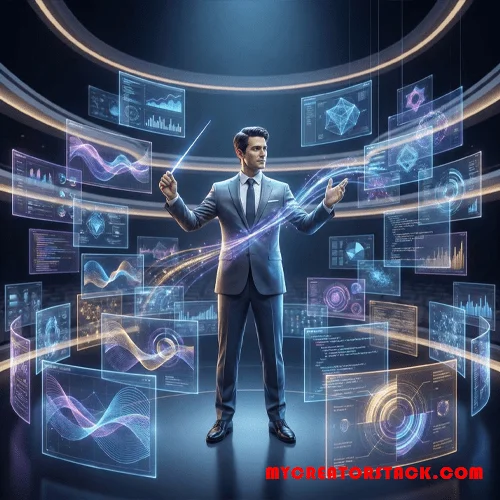
The future belongs to designers who stop viewing AI in graphic design as a competitor and start viewing it as a highly competent, lightning-fast junior assistant.
The role of the graphic designer is changing to that of the creative director.
In the past, you might have used 80% of your time on execution—retouching images, kerning text, resizing images for ten different platforms—and only 20% of your time on thinking creatively.
But AI changes this equation.
You can now use your mental energy on the high-leverage activities of strategy, ideation, client relationships, and creative direction. The executional work can be done faster with AI, so that you can prototype ideas instantaneously and explore ideas that would have taken days to visualize.
You are no longer just the painter holding the brush; you are the director of a digital orchestra.
Adapt to Thrive: How to Navigate the Shift
The space is getting crowded, and it’s happening mainly at the entry level, where technical skill was once enough. But strategic, high-value design, which can now be executed ten times faster, is full of opportunity. (If you are looking to optimize your toolset to match this speed, check out my recent guide to the best affordable design software). Here’s how to position yourself for success:
- Sell Solutions, Not Assets: Change your conversation. Stop selling a “logo” and start selling “brand recognition.” Stop selling a “website mockup” and start selling “user retention.”
- Embrace Your Human Capabilities: Focus on the development of your human skills, which include communication, persuasion, and empathy. These are your competitive advantages and cannot be replaced by machines.
- Acquire Proficiency in the Language of AI: Familiarize yourself with the language of AI. Proficiency in “speaking AI” is essential to the power of one’s creative vision. AI is a new form of medium that requires proficiency.
- Develop a Point of View: AI is neutral. Your work doesn’t have to be. Develop a distinctive style, a unique tone of voice, and a strong definition of quality.
Conclusion

The days of purely technical design are over, and the era of AI in graphic design empowering strategic human creativity is beginning.
The tools will change, but the purpose will remain the same: using human thinking and visual ideas to solve human problems.
Industry Insight
The global market analysis of the generative AI market in the creative industry has shown that this market has the potential to grow to over $4 billion by 2025. This does not indicate that this industry is declining; it is spending heavily to get more value from its tools.
(Disclaimer: The information given in the article is for information purposes only, and the information is based on personal opinions and research. MyCreatorStack is not responsible for any decisions made based on the information given in the article. The links given in the article are affiliate/advertising links.)
Frequently Asked Questions (FAQ)
Q: Will AI replace junior designers?
A: AI won’t replace junior designers, and this is a fact. However, junior designers should be aware of AI and its potential to help improve their work.
Q: Is it unethical to use AI for client work?
A: No, it is not unethical to use AI for client work. However, it is worth noting that in the use of AI for client work, one can use it in creating mood boards and also in brainstorming ideas. On the other hand, in the use of AI in the production of the final product, it is worth noting that one ought to discuss this with their client, especially in the context of copyright.
Q: How do I use AI without losing my style?
A: One ought to let the design software finish the job when using AI, as this will help in keeping one’s style intact.
Q: What tools should I be familiar with?
A: You ought to be familiar with the big image tools, especially Midjourney and Adobe Firefly.

Sandaru is a senior graphic designer with over 5 years of experience in brand identity, digital design, and creative workflows. He founded Mycreatorstack to help designers and freelancers navigate AI tools, design software, and the evolving creator economy — without the hype.
Leave a Reply